

 8613480627251
I. Industry Background and the Limitations of Traditional Lead Anodes
Electrowinning is a core process in the hydrometallurgical extraction of non-ferrous metals, with insoluble anodes serving as a critical component that determines the efficiency of the operation. For a long time, the industry has predominantly relied on lead-based alloy anodes. However, these traditional electrodes suffer from high energy consumption and significant pollution—drawbacks that run counter to current industrial goals of energy conservation and emission reduction. Consequently, the development and promotion of a new type of electrode—one that is energy-efficient, highly productive, and environmentally friendly—has become an urgent industry necessity.
II. Key Advantages of Titanium Anodes
Compared to traditional lead-based alloy anodes, titanium-based coated anodes (Dimensionally Stable Anodes, or DSA) offer superior overall performance:
Significant Energy Savings: Titanium anodes can reduce cell voltage by more than 200 mV, effectively lowering energy consumption during the electrowinning process, with an overall energy-saving rate of 5%–10%.
Enhanced Production Efficiency: Titanium anodes can operate stably at higher current densities, thereby increasing the yield of cathodic products and boosting overall production efficiency.
Environmentally Friendly and Pollution-Free: They eliminate the critical flaw of lead-based alloy anodes—namely, their tendency to dissolve and degrade during electrolysis, which contaminates both the electrolyte and the cathodic products.
Long Service Life and Lower Long-Term Costs: Although the initial investment for titanium anodes is higher (approximately 1.5 to 2 times that of lead anodes), their service life is 2 to 3 times longer. Furthermore, the titanium substrate is not consumed and can be recoated for repeated use, making the total cost of ownership significantly lower than that of lead anodes over the long term.
Conclusion: The transition from lead anodes to titanium anodes is an inevitable historical trend and represents a significant industrial upgrade for the non-ferrous metal smelting sector. An ideal titanium anode should offer superior electrowinning activity, higher energy efficiency, and a lower overall cost. III. Comparison of Operating Principles: Titanium Anodes vs. Lead Anodes
1. Operating Principle of Titanium Anodes
Titanium substrates undergo surface treatment, followed by the application of platinum-group metal salts (such as ruthenium or iridium) and high-temperature sintering. This process creates an oxygen-deficient solid-solution coating of noble metal oxides. This structure facilitates free electron transport, offering excellent electrical conductivity and electrocatalytic activity, which efficiently promotes electrochemical reactions.
2. Operating Principle of Lead Anodes
In a sulfuric acid system, lead anodes function primarily through the oxidative action of lead dioxide (PbO₂):
Anodic reaction: PbO₂ + 2e⁻ + SO₄²⁻ + 4H⁺ = PbSO₄ + 2H₂O
Cathodic reaction: Pb - 2e⁻ + SO₄²⁻ = PbSO₄
Overall reaction: PbO₂ + 2H₂SO₄ + Pb = 2PbSO₄ + 2H₂O
Note: Lead sulfate is sparingly soluble in water; therefore, lead anodes experience minimal dissolution and consumption during standard electrodeposition. However, the presence of chloride ions (Cl⁻) in the solution leads to the formation of lead chloride (PbCl₂), which is highly soluble in water. This rapidly disrupts the reaction equilibrium, causing accelerated dissolution and consumption of the lead anode, thereby significantly shortening its service life.
IV. Selection of Titanium Anodes for Different Electrolyte Systems
Currently, the electrodeposition of cobalt typically employs either chloride or sulfate systems, while the electrodeposition of nickel primarily utilizes sulfate systems. Titanium anodes with specific coatings must be selected based on the electrolyte medium:
Chloride systems (chlorine-evolving anodes): Utilize noble metal oxide coatings based primarily on ruthenium (Ru).
Sulfate systems (oxygen-evolving anodes): Utilize noble metal oxide coatings based primarily on iridium (Ir). Typical Operating Parameters and Service Life
Chloride System (Ruthenium-Coated Titanium Anodes)
Cl⁻ Concentration: 60–150 g/L
pH Range: 0–2
Solution Temperature: 50–70°C
Current Density: < 250 A/m²
Service Life: > 18 months
Sulfate System (Iridium-Coated Titanium Anodes)
Acid Content: < 150 g/L
pH Range: 1–3
Solution Temperature: < 60°C
Current Density: < 300 A/m²
Service Life: > 36 months
V. Typical Application Case: Copper Foil Electrodeposition
Iridium-coated titanium anodes have been used in the electrodeposition and post-processing of copper foil within sulfate systems for nearly 20 years, with the technology now being highly mature. Key advantages include:
Pollution-Free: Zero contamination of the electrolyte, eliminating the need for complex lead-removal systems.
Dimensional Stability: The anode maintains a fixed shape and does not deform due to dissolution, ensuring the quality of the cathodic product.
Repairability: The titanium substrate is not consumed during electrolysis and can be recoated repeatedly, significantly reducing substrate costs.
High Energy Efficiency: High current efficiency and low cell voltage.
VI. Emerging Application: Nickel-Chromium Alloy Electrodeposition
The electrodeposition of nickel-chromium alloys is an advanced plating process developed in recent years. Nickel-chromium alloy coatings can serve as a substitute for traditional chromium plating in many applications. They are widely used in sectors such as automotive, shipbuilding, home appliances, industrial machinery, chemical equipment, and the defense industry, creating new market opportunities for titanium anodes.
J&F Precious Metal Recovery: Professional Recycling of Spent Titanium Anodes and Industrial Waste Containing Precious Metals
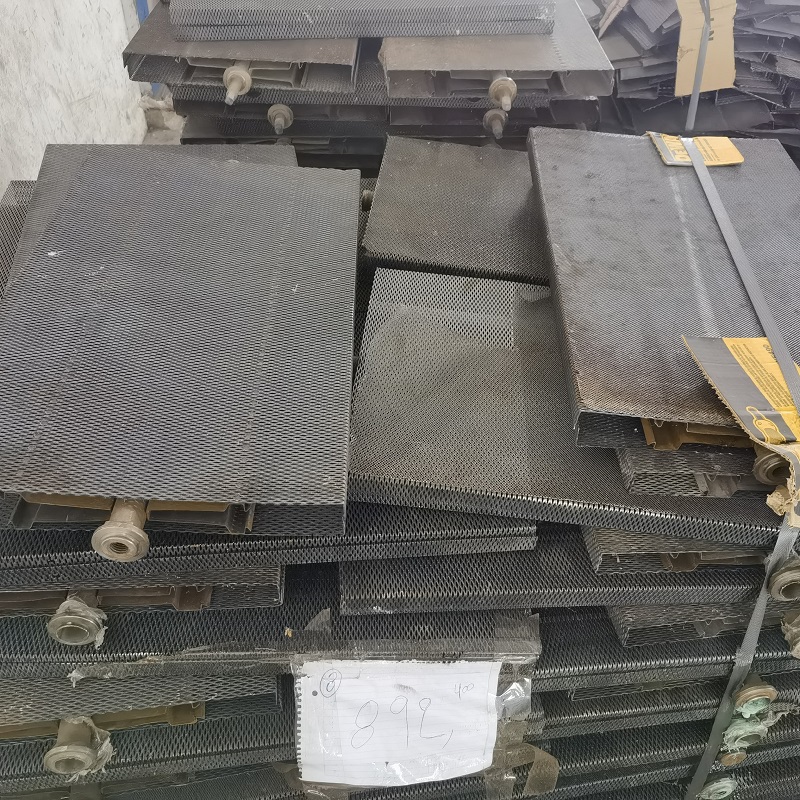
Dongguan J&F Precious Metal Trading Co., Ltd. specializes in the recovery of industrial waste containing precious metals, including spent titanium anodes, ruthenium-iridium coated titanium mesh, iridium-based coated titanium plates, platinum-plated titanium electrodes, precious metal catalysts, and other industrial materials containing precious metals. For spent titanium anodes—such as those generated by industrial wastewater treatment plants, manufacturers of electrolytic chlorine-production equipment, electroplating facilities, and other industrial users—we provide a comprehensive recovery assessment. This process begins with an initial evaluation based on material type, substrate condition, residual coating, and available compositional data, followed by a final recovery plan informed by precise analytical testing. To streamline this assessment, we recommend that clients provide—in advance—photographs of the materials, their quantity (or actual weight and dimensions), their original application, and any existing composition analysis reports. For materials with unknown or mixed compositions, we can coordinate sampling, testing, and on-site inspections to accurately determine the recovery value of precious metals such as ruthenium, iridium, and platinum.
If you have spent MMO (mixed metal oxide) titanium anodes, ruthenium-iridium coated titanium mesh, platinum-coated titanium electrodes, or other electrolytic waste containing precious metals, please contact J&F Precious Metal Recovery. Simply provide photographs and basic details about your materials to receive a tailored recovery assessment.
